The Birth of the Aminta Project

Penelope Appleyard (Fillide) & Angela Hicks (Aminta)

The Launch – 26 & 27 May

On a day in May 2019 a small group gathered in the Reading Room of a pretty village buried deep in beautiful Wiltshire countryside. They included the highly talented sopranos Angela Hicks and Penelope Appleyard, who make up the duo Fair Oriana, along with the harpsichordist Satoko Doi-Luck, director of the Ensemble Molière and also the ensemble Ceruleo. Oh, and of course me. Sadly, Satoko was prevented from being with us in the morning as she was still suffering the effects of an overnight indisposition. Our objective formed what would be the first tiny steps towards realisation of a burning and long-held ambition of mine – to restore Baroque opera to its full exotic and colourful glory, grace and elegance utilising the movement and gesture of the period.

Tiny steps certainly. The chosen work is not an opera but ‘Arresta il passo’, more generally known today as Aminta e Fillide, an extended cantata composed by Handel in Rome in 1708. Scored for two sopranos, strings and continuo, its Arcadian setting in which the shepherd Aminta (to be played by Angie) pursues his love for the reluctant shepherdess Fillide (Penny) nevertheless provides sufficient dramatic scope to challenge us for a first attempt. Our initial task was to read through the libretto in English in an attempt to find a response to some of its emotional demands. I have for some time felt that the relatively few attempts at using Baroque gesture so often founder at the starting gate because they look to have been externally imposed. Rather they should arise from within the singer in a naturally expressive way. This is no easy task for modern singers, whose obvious inclination is to respond in a 21st century, not 18th century way. It is something that will need a lot of work with singers that have never previously worked with gesture.

Having worked our way through the reading the plan was to concentrate firstly on the recitatives. But we were still without a keyboard player. This is where Angie and Penny showed their outstanding musicianship. For the rest of the morning and the early part of the afternoon they went through all the recitative without keyboard support, not only pitching it perfectly but additionally showing a keen dramatic instinct in projecting it. Gesture, too, started to show the first signs of arising from the emotional response to the situation; at the crucial moment where Fillide finally concedes to Aminta’s entreaties a real sense of dramatic interaction and frisson between the two made itself excitingly clear.

Satoko made a heroic mid-afternoon appearance, but by this time we had lost Penny! She had, at inevitably short notice, been informed of her husband’s return from a tour of duty with the RAF. Understandably, she wished to greet him, so once Satoko’s harpsichord had been installed we ran through Aminta’s arias, at the same time introducing gesture. However I am convinced there should be far less movement in arias than in recitative; it is intensely distracting to see singers flapping around as if giving semaphore signals during an aria, when the singer is trying to seduce us, the audience, with their singing and we do not want to be distracted from it. I was delighted to discover that my singers are able to incorporate another aspect of period practice, the ability to improvise ornamentation in da capo repeats. At my request Angie tried adding decoration in this way and the results of her modest variations were excitingly innovative and encouraging. By the end of the afternoon we had worked our way through all Aminta’s arias and I had heard enough to feel that we had set something truly special afoot.

On the following morning we all assembled together in one place for the first time, though not before Satoko (now fully recovered) and Angie – who had stayed locally overnight – took an unscheduled trip round the Wiltshire countryside. Given the lovely sunny morning the detour was entirely forgivable! First up this morning were the arias of Fillide, which also went very well given Penny’s study of them is not yet complete. We also talked of another beautiful embellishment used extensively in the Baroque, but all too rarely employed today. This is the messa di voce, the gradual crescendo and decrescendo of a sustained note, used especially in slower, expressive arias. Penny demonstrated a lovely example in one of Phillide’s arias and knowing we can introduce them adds a further dimension to our performance potential.

It was now time to put everything together with a complete traversal of the cantata, which I wanted to happen without interruption from me. One of the most important things this revealed, though it had also been apparent in Aminta’s reactions to Fillide’s arias, is that while it is not too hard for the singers to be encouraged to use gesture while they are singing, it is infinitely much harder for them to react appropriately when listening to the other character. What they cannot do is distract attention from the singer, so they must remain largely still, with the exception of interludes provided by instrumental ritornelli when some movement is possible, perhaps even desirable. We found that both Angie and Penny tended to fairly quickly ‘fall out of character’ during the other’s arias. It is something we tried to work on in our final afternoon session, but it is a problem to which a lot more thought needs to be devoted by me before we next meet. Following an agreeable pub lunch, that afternoon session was devoted to attempting to further integrate gesture with the emotional content of the arias and the interaction between the two.

We concluded an immensely rewarding couple of days in the realisation that while there is still far to go, the Aminta project was well and truly under way. And for me had come the huge reassurance that I was working not only with real talent – which I’d not needed to be told – but just as importantly with truly receptive and intelligent singers, not something to be gainsaid! It is a privilege to work with Angie and Penny, to whom I offer my grateful thanks in addition to those due to Sakoto for her splendid support. Here’s to the next chapter …

It had been my intention to follow the Aminta Project through to the performance given at St George’s, Hanover Square, London (by happy coincidence the church in which Handel worshipped) on 28 November 2019. Conducted by Leo Duarte with members of the Orchestra of Opera Settecento, it was immensely satisfying if not perfect presentation that proved conclusively how on the course of under ten months singers today can achieve a strong grasp of the feel of baroque gesture


What do we do with a problem like Baroque Opera?

One of the paradoxes of the modern revival of interest in Baroque opera is that it is a form unsuited to life today. We live in an era in which we are increasingly likely to tear from one moment in our lives to the next, barely registering the experience before moving on to take in the next one. True, for the more culturally inclined there are exceptions. In the world of music we might point to the symphonies of Mahler or Bruckner and, arguably most notably, the operas of Wagner, all if attended to in the way they demand requiring rather more than today’s default two-minute attention span.

It may come as a surprise to some that measured by time-span Baroque opera, or more specifically Italian Baroque opera, can often compete with time-defying Wagnerian amplitude. Compete with but not be compared with. The ethos behind the extreme flexibility and fluidity of Baroque opera stands at the opposite polarity to the Werktreue rigidity and marmoreal grandeur of the Wagnerian Gesamstkunstwerk (literally ‘complete art work’). Yet so hidebound are we by traditions dating back to the 19th century that in reviving Baroque opera we frequently strangle its innate freedom, pushing the genie back in the bottle in the process.

So how do the needs of Baroque opera differ so markedly from those of the 19th century? Well, for a start we must abandon the concept of a musical work, for no form in the canon of Western art music demonstrates mutation and variability to a greater degree. When a composer – not always the principal component in the greater scheme of things – was commissioned to write an opera he did so in the knowledge that he would be writing it for the leading singers contracted. If he had worked with, say, the prima donna previously he would have a fair idea of the kind of aria that suited her or that she favoured or even require. Otherwise he would be dependent on trial and error and expect to make many changes during the course of rehearsals and even after a run of performances had started. Were his opera lucky enough to be revived, probably in another city, it would often bear little resemblance to the original. New local conditions, a different cast and other considerations would determine that his opera may at times have metamorphosed into what was tantamount to being a new work, even at times including the music of other composers.

This contradiction of the concept of the work also played a considerable role in reception, in which social conditions played a major part. In Italy in particular public opera going played an important role in social life after its exponential rise in popularity during the second half of the 17th century. A key aspect of this phenomenon was the role played by the system of theatre ownership and box ownership by notable families in leading operatic centres like Venice, Naples and Rome. Such patronage was far from being restricted to viewing and hearing the opera. If you owned a box you might well go to several performances during the run of an opera, but equally you might not go to the whole performance. When you did you found other ways to amuse yourself or socialise during the course of an opera with which you had already become familiar, perhaps attending to only your favourite arias or favourite singer. Indeed one bemused English traveller found that some Neapolitans never socialized at home, conducting all their wining and dining in their private box at the opera. It was a unique culture, more often than not misunderstood by northern European observers

When we turn to the operas themselves we find further problems linked to their staging today, both practical and intellectual. The major practical problem is stagecraft. In major centres opera was staged with spectacularly grandiose sets, often designed by leading architects of the day and incorporating complex machinery that allowed for fantastical effects such as gods descending from the heavens on clouds that audiences came to expect. Today such effects are beyond all but the most generously funded houses or the two or three historic theatres still equipped with original stage machinery. Opera plots, too, are a problem for modern audiences, since they invariably fall into one of three categories: mythological stories, stories drawn from the great classics of Italian literature or stories based around actual historical figures. All three genres featured topics that were thoroughly familiar to the kind of cultured audiences that patronized opera in the 17th and 18th centuries. All three feature topics that are largely unfamiliar to the majority of a 20th or 21st century audience. Additionally before the production of a new opera the libretto went on sale to enable its incipient audience to purchase it and thus peruse its contents before the performance. It is sadly a practice undertaken by only a very small part of an audience faced with an unknown opera today. The remainder are more likely to fall into the category of the couple I overheard some years ago at Glyndebourne. They had arrived to see Monteverdi’s Il ritorno d’Ulisse convinced they were attending an opera by the ‘other’ Verdi.

It is obvious from the foregoing that for many reasons if we are to indulge our recently acquired taste for the operas of Monteverdi, of Handel and, increasingly, his contemporaries compromise will be involved. We are not going to sit solemnly in a darkened theatre for three or four hours during which the slightest crackle of sweet paper will inspire outbursts of ‘shhh’s’. Neither will we be permitted to eat our dinner or be allowed to come and go as we please during the course of a performance that will also likely include ballets. But because we love ‘Lascia ch’ia pianga’ and the latest countertenor sensation we have of course compromised. Let’s be clear that given the extraordinary adaptability that is Baroque opera there is absolutely nothing intrinsically wrong with making it fit for purpose in the 21st century. But it should be equally clear that both sensitivity and understanding should play a major role in any approach to the genre. Too often they have not and do not.

The early days of modern interest in Baroque opera, almost entirely devoted to Handel and largely if by no means wholly centred on Germany, saw the operas traduced in various ways. In particular roles intended for castratos (male sopranos or altos) were transposed for tenors and even basses, thus making them more acceptable and ‘believable’ to early 20th century audiences. Such transposition meant that at the same time the composer’s tonal relationships were often destroyed. In addition to cuts (on which more later) the careful balance and emotional weight of the da capo aria, with its A-B-A structure, was not infrequently undermined by omitting the central B section and repeat of A, the former often bringing new and contrasting ideas and emotions. Today these aberrations by and large lie behind us, having been replaced by other equally egregious horrors.

I would suggest these mostly concern the near entire takeover of Baroque opera by mainstream producers, a benighted profession mercifully unknown during the 17th and 18th centuries. This not simply a case of their updating or setting scenes in locations starkly at odds with the original intentions of the librettist and composer. Neither is it just a case of them having singers indulge in grotesque actions completely at odds with the nobility and sensitivities of the text they are projecting. Rather it is the (often deliberate) misunderstanding and betrayal of an art form to enhance the egocentric world-view of such producers that is the real crime.

Consideration of performance criteria and standards reveals a happier if far from perfect state of affairs. The emergence of period instruments and with them lower Baroque pitch(s) in the latter half of the last century has brought with it greater understanding of the role and sound of the orchestra we use for operas of the period. Less praiseworthy is the function played by continuo instruments in later Baroque operas, fundamentally harpsichord and cello, but now invariably augmented by lutes of varying sizes that often impose themselves far too forcefully. Even worse is the recent addiction to the harp as a continuo instrument, an instrument totally unsuited to such a role and an anachronism that needs to be abandoned as swiftly as it arrived. It must be stressed that these observations do not apply to operas of most of the 17th century, where the support for the singer played by the continuo group before the emergence of the orchestra plays a completely different role.

The singing of the operas of the period today reaches a far greater level of overall competence and stylistic awareness, though I would argue it has regressed since the days (1970s and 80s) of the early music ‘ghetto’. The incorporation of early opera into the mainstream has brought with it the widespread use of all-purpose singers, many of whom see early music as a stepping stone toward a bigger and better career. Indeed it is not uncommon for conservatoires to encourage them to do so, a profoundly unsatisfactory attitude. Such singers frequently fail to measure up to the demands of the repertoire, bringing to it a continuous vibrato that is not appropriate and that should not be as acceptable to conductors as it is. Most specialist singers are today capable of encompassing many of the right aspects of technique and encouragingly this now includes many southern as well as northern European singers. Thus runs are cleanly articulated and ornamentation generally reasonably stylistically applied and well turned. However two essential ornaments are in the tool box of far too few singers. I refer to the trill and the messa di voce (a crescendo followed by a decrescendo on an open vowel), both of which stood at the centre of conservatoire teaching in the 17th and 18th centuries but which on aural evidence appear not to be a part of it at all in many cases today. The other major failing concerns diction and textural clarity, the particular importance of which in the music of the Baroque all too few teachers or singers seem to recognise.

So how do we go about trying to solve the problems outlined in this essay? ‘What have we done well? What do we need to do better?’ I have put those questions in quotes as they formed part of a notification recently received announcing a conservatoire-organised conference titled ‘Early Music in the 21st century’ A perusal of the agenda soon revealed that far from attempting answers to these fundamental questions the conference would be largely devoted to arcane academic topics, or as was explained when I queried the content, ‘the intellectual underpinnings of the whole movement’, asking ‘The Big Why’! Frankly I’d rather hear a single cadential trill beautifully delivered than spend pointless hours in an ivory tower trying to thrash out the meaning of ‘The Big Why’.

There are more useful practical answers and if the reader has not yet come across my video ‘Toward a Better Understanding of Baroque Opera’ – https://www.youtube.com/watch?v=3SmJ5tfTvIk – I would like to suggest a viewing (it lasts c.30 minutes). There some of the ways in which we might enhance our appreciation and by extension love of the operas of Monteverdi, of Cavalli, the operas of Handel, of Porpora are discussed. Here I will simply conclude by summarizing two avenues that need urgent consideration. Firstly, we must wrest these operas back from the disrespect shown to them by producers and theatre directors in the name of making them more ‘relevant’ to 21st audiences. That does not mean a return to the lavish, sumptuous productions that are today beyond economic viability to all but a handful of opera houses. We have, for example, so far hardly scratched the surface of digital possibilities for creating stage sets. Neither does it mean the score is sacrosanct; we have already noted that it was not. Judicious cuts must therefore always remain an option but they must be done with sensitivity toward the structure of the opera and should involve whole arias, not the butchery of the arias performed. Then study of the Baroque gesture must become far more standard in the early music departments of conservatoires. This is not for the sake of making pretty patterns but because its correct application allows singers to identify far more closely with the emotions they are attempting to convey. More work is necessary on ornamentation in general and, above all, the trill in particular. We know the trill stood at the centre of the teaching agenda in the conservatoires of the day. It must be restored to that seminal place in every early music department. Finally, if we want to try to rediscover some of the visceral excitement of the first performances we might look more seriously at the art of improvisation, an art applied to their performances by the great singers of the period.

In many ways today’s performers of early music have revealed to us the untold riches of Baroque opera in ways many would at one time never have thought possible. It is surely not asking too much to go the final mile and do full justice to these fantastical, passionate works, one of the great treasures of our heritage.

The illustration that heads this essay shows the set for Handel’s Imeneo at the 2016 Göttingen International Handel Festival

Rebuilding Early Opera Performance

Recently I came across an interview with the doyen of classical architecture, Quinlan Terry celebrating the publication of his new book [1]. In the interview Terry describes his struggle to gain acceptance in a world in which rampant modernism had, to use his word, ‘brainwashed’ all but a few in the milieu of architecture. He was told by the Architectural Association that unless he submitted a design for a ‘modernist carbuncle’ for his final exams he would fail. His answer was to submit a parody of modernism, ‘a hideous building’, to again quote his own words. Needless to say the adjudicators loved it, thinking Terry had finally been converted to the conventional modernist way of thinking. As a practising architect, and despite (or perhaps because of) the advocacy of the likes of Prince Charles, Terry’s work, including his masterpiece the Richmond Riverside, has been widely excoriated by his critics, who describe his work in terms of tired clichés such as ‘chocolate box’.

What I found particularly striking about Terry’s observations is that he faced problems analogous with those met by those of us struggling to put Baroque opera on the map in a form that would be recognised by its originators and their audience. We face the same uphill struggle to overcome the same rampant brainwashed modernism that prevails in today’s opera houses, institutions long ago taken over by producers and their servile camp followers, opera administrators. Such is their arrogance that producers not only fail to recognise, but indeed feel no need to recognise, that the performance, staging and production of early opera have special requirements that differ from those of the mainstream. The way in which you approach putting a Verdi opera on the stage is not the way you go about staging a Monteverdi opera. Whatt the time the remarkable modern early music revival started around 1960 operas of the period were rarely staged. If they were – and it was nearly always one of a small selection of Handel’s with the odd Monteverdi

What particularly struck me about Terry’s observations is that he faced problems that were – and remain – analogous with those met by those of us struggling to put Baroque opera on the map in a form that would be recognised by its originators and their audience. We face the same uphill struggle to overcome the same rampant brainwashed modernism that prevails in today’s opera houses, institutions long ago taken over by producers and their servile camp followers, opera administrators. Such is their arrogance that producers not only fail to recognise, but indeed feel no need to recognise, that the performance, staging and production of early opera have special requirements that differ from those of the mainstream. The way in which you approach putting a Verdi opera on the stage is not the way you go about staging a Monteverdi opera. What we have today is in fact a regression. At the time the remarkable modern early music revival started around 1960 operas of the period were rarely staged. If they were – and it was nearly always one of a small selection of Handel’s with the odd Monteverdi Orfeo – it was generally by small niche companies that at least made an attempt to reproduce some kind of period style, albeit usually of a necessarily threadbare nature.

When early opera eventually entered the mainstream it was dragged willy-nilly into the prevailing culture of modernism and the cult of so-called ‘Regietheater’, or director’s theatre, a world dominated by left-leaning producers anxious to put their own political stamp on any opera they got their hands on. Such has become their hold over opera that over the past half-century it has been a brave conductor or critic to contest the hegemony of the all-powerful producer. To do so also runs the risk of falling foul of the posse of critics whose own lack of understanding of early opera is equalled only by those stage directors to whom they are in thrall. I was to discover this when being ‘cancelled’ by several such London opera critics for various sins but specifically that of expressing empathy with the trenchant views on the topic of unsympathetic modern production held by the late Winton Dean, the great Handel scholar.

Yet there can be grounds for hope and again we can to turn to Quinlan Terry’s interview to find them. He explains that when the Richmond scheme was put out for tender there was an alternative, ‘hideous scheme’, which might well have gone ahead but for the decision to present the two designs to the public and ask them to vote on them. Quinlan’s design won, being a good example of how when the public is asked for its viewpoint it generally comes up with the sensible answer. Much the same applies to opera. It has been shown on more than one occasion that faced with a choice between a realistic set and characters that behave like human beings as opposed to demented idiots screaming among a pile of detritus, it will, with the exception of the irrevocably brainwashed, choose the former. In my own modest way I have proved how a return to staging Baroque music drama with the correct movement and gesture can return to this music its inherent beauty, grace and elegance. The performance of Handel’s dramatic cantata Aminta e Fillide given in London in 2019 (and repeated in Vienna in January 2022) proved how positively an audience will respond to such a presentation. Very recently someone that attended the London performance – not an avid opera goer – told me without solicitation how it had left a lasting impression on them, how they still recall the sheer beauty of the performance. It is such a reaction that makes one realise that for all the hold ugly modernism has on opera the seemingly endless uphill struggle to restore early opera to its true state is not just worthwhile but necessary. Until we do there can be no real understanding of a genre we have rediscovered only in our lifetime.

[1] The Layman’s Guide to Classical Architecture, Boförlaget Stolpe

John Nelson conducts Berlioz’s Roméo et Juliette

Roméo et Juliette, Strasbourg, June 2022. Photo © Nicolas Roses

In the wake of the legendary Colin Davis era of Berlioz performance and recording, no one has trodden the path of successor more assiduously than the American conductor John Nelson. Not the least remarkable thing about Nelson’s project to record the major works with the Orchestre philharmonique de Strasbourg for Warner on the Erato label is that it started only in 2017, by which time the conductor was already in the mid-seventies. Highly-lauded recordings of Les Troyens (2017), La Damnation de Faust (2019) and the Grande Messe des morts (Requiem) (2019) have to date appeared. In a review for Opera magazine (July 2019) I wrote that Nelson had: ‘[confirmed] himself as the Berliozian de nos jours, a worthy successor to Colin Davis. The evening made for a triumphant addition to the Berlioz anniversary celebrations, there being little doubt that the subsequent recording is in line to repeat the award-littered success of Les Troyens’

The Covid pandemic obviously brought a temporary halt to activity, during which time Nelson experienced an unrelated illness. However at the beginning of June 2022 the cycled resumed with the performance and recording of Roméo et Juliette at two concerts in Strasbourg, succeeded by one at the Philharmonie de Paris. It was the last of these I attended on 10 June, but before turning to that a brief introduction to the work itself.

It is a direct reflection of Berlioz’s passion for Shakespeare, a passion shared by many French artists in the 1820s. As the Berlioz scholar David Cairns has observed, they found in the plays presented by a company brought to Paris by the English actor John Kemble an intensely Romantic emancipation from the stultifying academic atmosphere prevalent in the Paris of the period. For Berlioz, who fought against such pedantry his entire life, the discovery of Shakespeare came like a thunderbolt, to use his own word. In the Memoirs – arguably the best and certainly the most entertaining book ever written by a musician – he writes of how in the autumn of 1827 he went to see the Kemble company’s Hamlet and Romeo and Juliet, an experience that in a ‘lightening flash revealed to me at a stroke the whole heaven of art […]. I recognised the meaning of grandeur, beauty, dramatic truth […]’. It was not only Shakespeare who captured Berlioz at those performances; he fell head over heels in love with Harriet Smithson, the Irish actress that played Ophelia and Juliet. After five years of passionate pursuit, Berlioz would eventually marry Harriet.

Berlioz was enabled to write Roméo et Juliette as the result of the generous sponsorship of Paganini, who gifted him a sum sufficient to allow him to work on the score almost uninterrupted for seven months in 1839. Although never termed as anything other as a symphony – the score is headed ‘dramatic symphony’ – from the outset the symphony was planned on a scale and design unique in musical history, as Berlioz well recognised when he described it in a letter to his father: ‘the art form which it contained [is] totally new’. Although ostensibly cast as a four-movement symphony, three have text, crafted by Berlioz himself, the whole a musical interpretation of Shakespeare’s story told in graphic detail. When the work was first given in Paris in November 1839 the two performances were acclaimed to the point where the composer could describe them to his father as ‘probably the greatest success I’ve had so far’, the second performance in particular as ‘stupendous, overwhelming’. He continues, ‘At the end of the concert […] the whole orchestra and chorus stood up hurrahing loudly enough to bring down the roof of the hall’.

If the Paris performance conducted by John Nelson fortunately didn’t threaten to bring down the roof of the Philharmonie, it was certainly deservedly received with great acclaim. Nelson today cuts a frail figure on his journey’s to and from the podium, but this did not prevent him from the ability to inspire the augmented Strasbourg orchestra to playing of the greatest fervour and affecting sensitivity. The extraordinarily bold writing in the passage marked ‘Roméo au tombeau de Capulets’ – a sequence of extreme conflicting emotions – came across with vivid, searing intensity. The only caveat would be some less than totally precise brass ensemble, but against that can be placed the glitteringly agile wind playing in the Scherzetto that ends Part 1, ‘Bientôt de Roméo’, its patter superbly delivered by tenor Cyrille Dubois. In the opening sections Nelson was fortunate to have no less a luminary than Joyce DiDonato, who has been a mainstay of his Berlioz cycle and who here sang the Strophes section with utterly gorgeous tone. Less satisfactory to my mind was Christopher Maltman’s Père Laurence, who although he brought great authority and dignity to the Finale and reconciliation scene sang with an unremitting wide vibrato. The chorus (Gulbenkian and l’Opéra national du Rhin), too, was less than convincing at times, though some of that may have been down to the not ideal acoustics of the Philharmonie. Notwithstanding, overall the performance was one to renew admiration for the astonishing originality of Berlioz’s conception and for John Nelson’s splendid ongoing Berlioz cycle.

The Ambronay Festival – September-October 2022

Illustration: Handel – cantata Apollo e Dafne – Yannick Debus, Keteryna Kasper & the Freiburg Baroque Orchestra, cond. René Jacobs

Regular readers of Early Music Review may recall my long-standing love affair with the Ambronay Festival, one summed up in my personal retrospective on the occasion of the festival’s 40th anniversary in 2019. For those not familiar with earlier reports or the festival, I’ll remind readers that Ambronay is located in a village some 35 miles northeast of Lyon. It lies close to the foot of the pastures and thickly wooded hills of the Haut Bugey, pre-Alps forming a southern continuation of the mountains of the Jura. It’s a pleasant if unremarkable kind of place, the kind you might easily drive through without noticing the medieval Benedictine Abattiale set back from the main street. Yet Ambronay and its abbey, the latter blessed with outstanding acoustics, are home not only to one of Europe’s most prestigious early music festivals, but also to an ambitious cultural centre of worldwide importance, founded in 2003. Over the years both festival and facilities have grown considerably; since 2009, my first year at the festival, the sensitive restoration of the 18th century monk’s cells to provide accommodation for artists and even critics (!), and the Monteverdi Salle for the presentation of smaller-scale concerts have been notable landmarks.

The Covid pandemic and the many problems that came in its wake have ensured a longer than usual break in visits to Ambronay, but we (my partner Anne and myself) were delighted to be able to resume acquaintance for the 2022 festival, were the welcome was as warm and hospitable as ever. The major change that has taken place is that the festival now has a new director, or more correctly directrice générale. Isabelle Battioni may have been appointed only fairly recently (this was the first festival the planning has been fully in her hands), but she is not new to Ambronay, having been deputy-director when we first started going to the festival.

As is customary the 2022 event is spread over four weekends from mid- September into early October, this year with the characteristically enigmatic theme ‘Musiques Enjeux, Musiques en jeu’ (a play on words for which I cannot come up a satisfactory English version). We had chosen the first weekend (16-19 September), which incorporated the splendid journées européennes du patrimoine, a weekend promoting cultural places and activities during which historic buildings normally closed to the public open their doors, while others grant free admission. Ambronay contributed with guided tours of the abbey, a fête day in its park and spectacular illuminations projected onto the outer walls of the abbey. Musically the weekend featured revered artists such as René Jacobs and Les Arts Florissants that have played a major role in the festival over the years, but a younger generation of musicians like the vocal ensemble Cantoría and the medieval group Sollazzo were also represented. Completing the programme were the ‘fringe’ events involving ‘world music’ that have always played an important role at Ambronay.

A delayed flight determined that we arrived too late to hear Cantoría’s early evening concert, so our first taste of the festival came from René Jacobs’s concert of a pair of Handel’s early Italian cantatas, Il Delirio amoroso, HWV90 (not 99, as was incorrectly given in both the advance publicity and the programme for the evening) and Apollo e Dafne, HWV122). A generously constituted Freiburg Baroque Orchestra included a harp in the continuo section, an unnecessary anachronism in which Jacobs has now indulged for some time. The days when Jacobs was an outstanding early music director are indeed long past – he is now a far more reliable interpreter of Romantic repertoire – and his conducting here was stolidly north European, draining the youthful Italianate exuberance from Handel. It was an approach that provided little help to his singers. The Ukrainian soprano Kateryna Kasper has a voice of great character (she was an adorable Ännchen in Jacobs’s recent recording of Weber’s Der Freischütz) and in HWV 90 she displayed a good grasp of Baroque technique, with some neatly turned ornamentation and well-articulated passaggi. But the voice is too ample and unevenly produced for this repertoire, with impressive chest notes that nonetheless sound like those of a different voice. Ornamentation at cadences was wild and unstylish. Apollo e Dafne, drawn from Ovid, tells the familiar story of the god’s chase of the follower of Diana who in her desperation to escape Apollo’s clutches begs her father to change her into a laurel bush. Kasper was joined by the German bass Yannick Debus for the cantata. Like her, he is not an early music specialist (he was also in the Freischütz), but the voice is well produced and beautifully rounded; he also sounded more comfortable in this repertoire than Kasper despite, like her, not having a trill. The performance of what is one of Handel’s most dramatic early cantatas in fact built to an effective climax before Apollo’s lovely final aria, here taken at a funereal tempo that compromised its effect. In addition to the cantatas the programme included the overture to Agrippina and a capable if unmemorable performance of the Organ Concerto, op 4 no 5, played by Sebastian Wienand.

The following day brought two concerts by Les Arts Florissants. The first was an a cappella concert largely devoted to a complete performance of Schütz’s First (and only) Book of Madrigals, published in Venice in 1611. The concert opened with Giovanni Gabrieli’s 8-part Lieto godea sedendo and Questo felici erbette (from his 3rd Book of Madrigals, 1589) and Monteverdi’s O primavera, gioventù dell’anno, a welcome to spring which also forms the text of the opening of Schütz’s publication. As with Handel’s youthful Italian visit, the young Schütz’s stay in Venice under the tutelage of Giovanni Gabrielli played a fundamental role in developing not only an understanding of Italian culture but his mastery of composition. In the Madrigals we find an extraordinarily adept assimilation of madrigal style. Mostly written for five voices, the 19 madrigals employ (with a single exception) texts by Battista Guarini or Giambattista Marino, poets that will be familiar names to anyone acquainted with the repertoire. I’ve written in previous reports from Ambronay of the enormous pleasure of hearing tenor Paul Agnew’s madrigal performances with a special a cappella group drawn from Les Arts Florissants. They are characterised not only by a now near taken for granted finish and finesse, but also the intensely full-blooded and dramatic performances that Agnew inspires from an ensemble in which he is most of the time a participant. If there is perhaps less scope here for such drama as in the Monteverdi we’ve previously had from Agnew, it has to be recalled that these prima prattica madrigals were stylistically slightly old-fashioned by 1611. None the less a piece like ‘Alma, afflitta che fai’ (no. 3) came across with impressive power, while the rapid exchanges of ‘Fuggi, fuggi, o mio core’ were of several instances of an impressive level of virtuosity.

The Sollazzo Ensemble. Photo © Bertrand Pichène

Those that like the present writer are ancient enough to remember the early days of the 20th century early music revival may recall that one of the questions that came up for debate was lack of information regarding performance practice of medieval music. For some, like David Munrow, such ambiguity was relished, since it gave a freedom otherwise unavailable. But for others like Christopher Hogwood (who of course started as a member of Munrow’s Early Music Consort of London) it proved a frustration that so little authentic information was available, so, as did Hogwood, moved on. Critics are in a not dissimilar position, since few, including myself, bring specialist knowledge to the topic. All this provides preamble to the final concert of our Ambronay visit, given by the Sollazzo Ensemble, who we last heard as eeemerging contenders in 2015, when the group was rather differently constituted. They didn’t win, but were victors in the York Early Music Competition and from 2017 to 2020 were associate artists at Ambronay’s Cultural Centre. This year’s concert, under the direction of founder Anna Danilevskaia, featured what I understand was an unusually large version of the ensemble, no fewer than 18 performers in all. The concert, divided into five sections, included works by Johannes Tapissier, Matteo and Niccolo da Perugia, Guiraut du Bornelh, Johannes de Florentia, Vincenzo da Rimini, Pierre de Moulins, and, of course, a fair sprinkling of Anon. Inserted in the middle of the section entitled ‘Ecstasy and Faith’ contrast came with Arvo Pärt’s mesmerizing five-part a cappella setting of the Magnificat (1959), evocatively performed by recessed singers. It may well be that ignorance is indeed bliss, but as one that now rarely hears medieval music I found this concert as compelling as anything heard during the weekend, appreciating the sheer professionalism and exuberant verve of the more upbeat numbers, transported by the ravishing beauty and pain of a piece like Johannes de Florentina’s ‘Quand’amor’. It was touchingly sung by soprano Carine Tinney, the standout among the ensemble’s eight vocalists, who were none the less all excellent as was the instrumental contingent of various wind, bowed string and plucked instruments. More of a show than a concert, it was truly heart-warming to encounter so many outstanding young musicians on a concert platform.

A William Byrd Commemoration in France

Situated some 35 miles south of Calais close to the smart Opal Coast resort of Hardelot, the chateau that bears the same name has roots that extend back as far as the 13th century, when the first castle was built by the Duke of Boulogne. Much fought over during the following centuries, in the 17th it was pulled down by Cardinal Richlieu and left untouched until in the early years of the 19th century it came into the possession of an Englishman, Sir John Hare, who rebuilt the chateau in the present neo-Gothic style. Under the present auspices of the Pas-de-Calais département it is a Franco-British cultural centre designed to celebrate the entente cordiale. Following refurbishment completed in 2009, a Midsummer Festival was created that today attracts some of France’s leading early music practitioners.

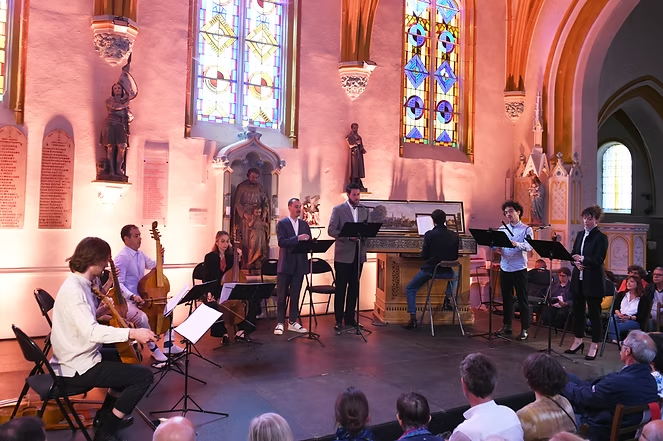
The 2023 festival was held on the last two weekends of June, the second of which we attended. Two of the major events were dramatic works held in the impressive Elizabethan theatre built in the grounds and opened in 2016. Those I have written about in Opera magazine. The third was a commemoration of the 400th anniversary of the death of William Byrd, which took place in the mainly 15th century village church of Condette, a short distance from the chateau. It was given by Ensemble Près de votre oreille, which lived up to its name by having the audience surrounding the players and singers on three sides, meaning no one was far from the performers. On this occasion the Ensemble consisted of four singers, virginals and four gamba players under the direction of Robin Pharo. The programme, a mixture of sacred and profane, used the Mass for 4 voices as a centrepiece interspersed by music for viol consort and virginals. Doubtless they would argue that in a context of this kind the mixture is legitimate, but what to mind did not work was Ronan Khalil’s virginals accompaniment for the Mass, to which the viols were added at climatic moments. Byrd’s sublime a capella polyphony was thus fatally compromised, at no point more so than at the close of Agnus Dei, where the unforgettable move from minor to major invites light in flood the final moments of the work. That such addition was superfluous was proved by the beautifully toned and integrated singing of the vocal quartet (Amélie Raison, Paul Figuier, Clément Debieuvre and Romain Dayez), whose performance, more emotional than we are used to with British performers, needed only slightly more nuance to have been outstanding.

On their own account the viols produced outstanding playing in a variety of works, the In Nomines and Fantasias inducing especially compelling playing. Ensemble Près de votre oreille is undoubtedly a first-rate group but on this occasion their integration of voices and instruments produced dubious results.

The photo of Ensemble Près de votre oreille is copyright Pascal Brunet